
A Message for Olivia Colman

(Picture: Olivia Colman at an award credit Mr Wallpaper)
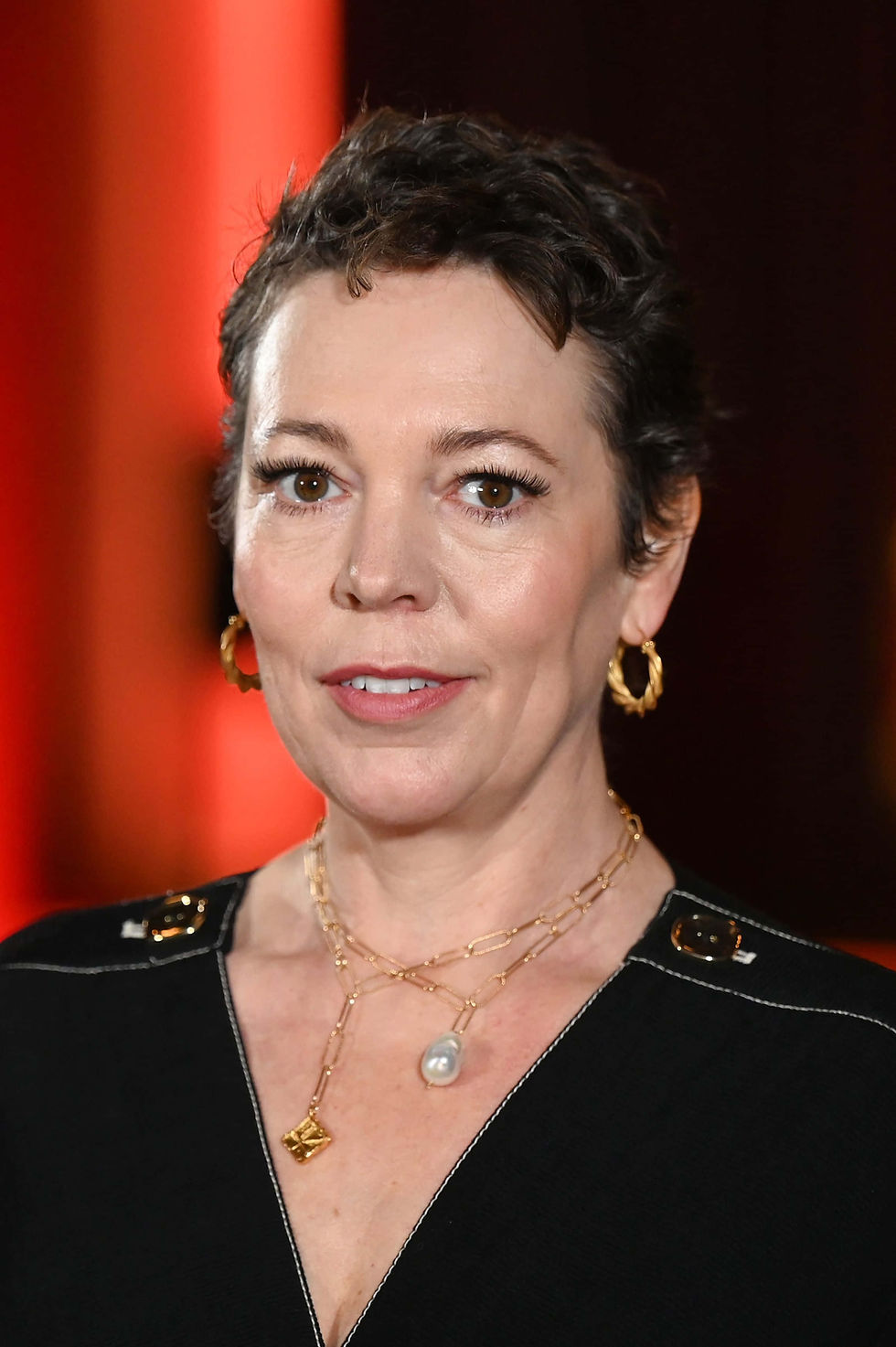
Actress Olivia Colman has caused controversy following an interview with Them magazine, during which she announced that ‘I’ve always sort of felt non-binary’ and that ‘I’ve always described myself to my husband as a gay man’. This was followed by a widely circulated video clip in which Olivia addressed people who are ‘against trans rights’ (which presumably includes women fighting to retain their rights in law), stating that ‘I don’t know how you explain to them what understanding and kindness is… and love’.
The interviews were to promote her latest film, Jimpa, about a woman, who takes her non-binary child (played by ‘trans non-binary queer’ identifying Aud Mason-Hyde) to visit her gay father, played by John Lithgow.
Colman is lucky – she is talented, feted and wealthy and as such, she will never be on the sharp end of the sorts of policies that are so badly affecting less privileged women; the placing of men in women’s prisons, rape and domestic violence shelters and other vital single sex spaces.
Her remarks have been profoundly upsetting given the innate vulnerability of autistic girls and young women. Not only do they make up a significant cohort of referees to Gender Identity Clinics, but more widely, research shows nine out of ten autistic women have experienced sexual assault and are three times more likely than the general population to experience domestic abuse.
In September 2020, The Women’s Equality Party held an internal review when deciding whether to support a policy of single sex spaces for women. One of our parent supporters, an autistic woman, was invited to submit testimony to the review, as a WEP member with experiences of domestic violence and sexual assault.
In response to Colman’s remarks she has agreed to let us publish her testimony in full. We have redacted her name in order to protect her privacy. We hope that if Olivia Colman reads this (or indeed any of the politicians or celebrities currently criticising women and girls for protecting their rights in law) she – and they - will have a better understanding of exactly why so many autistic women are fighting hard to protect and safeguard our autistic children and fight for our right to single sex provisions to be implemented in law.
The testimony was written and submitted in September 2020, 5 years before the Supreme Court clarification that Sex in EA2010 refers to biological sex.
Submission to the Women’s Equality Party Sept 2020 Ms __________
Firstly a trigger warning, because to understand why single sex spaces are so important, I need to talk about rape and abuse.
And to say that this isn’t about personalities, or rhetoric or fights or even feelings. It is about the law and what the law says in a democracy; how laws are created or amended and the effect this has on wider society matters hugely. And that women are allowed to talk about our rights.
This whole debate has been framed by the media as women talking about Trans rights, which people assume is none of our business. But we are not talking about that; we are talking about our rights; women’s rights and how they will be hugely affected by self-ID and the relaxing or removal of the sex based exemptions in the Equality act. We are continually portrayed as the bad guys, but all we want is to keep the rights we have in law.
I was raped at a very young age. And because the path we start on determines the paths we choose, I absorbed the powerful message that I was worthless. I spent years of my life living with domestic violence. I’ve been kicked in the head, pushed down the stairs, kicked in the stomach and thrown across rooms. Been grabbed by the hair and had my face banged into the wall over and over again, while he shouted ‘Shut Up. Shut Up’.
He rained punches onto my face, while I was unable to move after a caesarean, when I’d just given birth to his child the week before. And then he spent the night crying until I said sorry. Because that’s what they do. They give us their shame and we make it ours and we shove it inside ourselves, until it becomes part of us.
By the time I started to think about leaving, I had cheap mobile phones hidden in the bathroom and kitchen in case I needed to call the police in the middle of the night. I should have left then, but I wasn’t thinking rationally, I was thinking about how to survive. Years later, long after I left, a thought came in to my head, clear and bright and loud; ‘Thank God, he can’t kill us now’ and I was shocked by the force of it, rising up out of nowhere and then I remembered how afraid I was.
When you live with that level of fear, it becomes part of you, leaching into your bones. It had been there since the night he stood up in the middle of a football match and said, calmly, ‘I’m going to kill myself, but I’m going to kill you first, because you’re worthless’. And I believed him. And then he tried to strangle me and the woman on the end of the phone told me that he wouldn’t stop, and that eventually he would turn on our children.
Which is why it is essential, and understood and given, that we have spaces where there are no men. Spaces where we can breathe and begin to recover, knowing that that hideous, cortisol rush that paralyses us with immediate fear, can abate and we can start the long, sometimes lifetimes work of reclaiming our bodies.
Where our children can play and not feel afraid. Not wait for the turn of a key in a lock and feel their stomachs turn over and I have to watch them freeze while I pretend desperately that I’m not freezing myself.
And all of those feelings are carried with us all of the time. Everywhere we go. And we remain on constant high alert. Abuse and gaslighting destroy trust, and living with the aftermath of rape is like being destroyed from the inside out, every single day.
To walk through every area of life on high alert, to be afraid at random moments that you can’t predict. To try and teach your children that the world can be a truly wonderful place and there are good men in the world. A concept that is alien to them.
Good men, real men, outside Avengers movies, because right now, they are the only good men that my son has ever seen being strong and compassionate and loyal. Choosing the side of the light, however hard that might be, because it’s the right thing to do. They aren’t even real. But that’s all he’s got. My children have years of work to do to unpick their fear that their experience of domestic abuse has left them with.
My children, in a shelter, can’t be expected to pretend that they believe someone is a woman when they aren’t. Because it’s not about identity. Their instinctive trauma response to a male voice can’t be faked or covered up or suppressed and it would be an inhumanity to even consider asking them to.
And single sex spaces provide that brief opportunity for respite. The spaces we take our children and ourselves. And the law allows us to do that. We have the right to do that. And I am honestly floored that in 2020 we are even having a conversation about why, if we ask nicely, we may be allowed to retain the rights we already have. Because as women, our desire to be seen as kind and nice and inclusive, the result of a lifetimes socialisation, is the one thing that will ensure that those rights are taken away. Exclusion is not a dirty word. It isn’t a horrible word, uttered by horrible people. That’s just rhetoric. Exclusion is not casting people out into the wilderness, or denying them their humanity.
It is simply, in legal terms, a mechanism that is part of a framework that is built into the Equality Act. Exclusion is built into the Equality Act. The Equality Act wasn’t designed to allow everybody to have access to everything. It is designed to prevent discrimination, to allow the raising up of protected groups so that the institutional barriers that stand in our way are removed and we are levelled up. It is designed to protect those who need it. And we, as women, are given areas of protection over and above others and sometimes above gender reassignment, for a reason.
Women of faith or from cultures that don’t allow them to share intimate spaces with males. Women like me who suffer from complex PTSD as a result of years of coercion, sexual abuse and violence; where will we go to heal? Where will we go to feel safe?
One of the arguments that is repeated is that if males want to hurt us, if they want to break the law, they’ll do it anyway. That a man determined to rape, will just push past doors and signs and pursue his victim. Which may well be true. But it also misses a very important point. The vast majority of men, who do the things that make women and girls feel uncomfortable, aren’t rapists at all; they’re opportunists. A very few men may kick down boundaries and rape and assault, but most don’t.
But there are some who will take advantage of the cracks in changing room walls, or grope and grab or stare at our bodies until we have to look away with shame. These are men who think our boundaries are optional.
These are the men who are placing spy cams in the cubicles in communal gender-neutral changing rooms and toilets. Because they’re allowed in with us. Primark, Marks and Spencer’s, Sainsburys, Top Shop, Local Authority Leisure centres, The Old Vic Theatre, The Barbican, schools up and down the country. All gender neutral and all fair game. They come in and place the tiny cameras, (£10 on Amazon!) up high in the cracks of the cubicles and harvest the footage a week later – they edit together all the women and girls getting undressed and upload them onto free porn websites. And none of us will ever know if we are the stars of this newest form of homegrown porn.
These are the men that we escape from in nightclubs, by fleeing to the safety of the female toilets. These are the men who won’t follow us in, because they know that society says no. Because they don’t want to get called out. But who, if you make everything unisex, or say that males can enter female spaces if they say they are a woman, will get drunk and think it’s ‘a right laugh’ They’ll follow women who they are hassling or making feel nervous, into the gender-neutral toilets so that she will never again, have anywhere to go where he may not go too. And if you can look into your heart and say that you’ve never been that woman, then you are very lucky.
The men who are too cowardly to cross a boundary if society says no, but will gleefully, drunkenly cross it with impunity, if society says they can. But we are told that if women or girls encounter men or boys where they are not supposed to be, we should just sit with our discomfort. We should be the ones to move. After all, that’s what Stonewall tell us, and what they are asking schools to teach our daughters. Teach them to dismantle their boundaries and sit with their discomfort so that they don’t hurt male feelings.
How lacking in empathy does a person or an organisation have to be, to say. ‘Sorry about your fear and discomfort, but the thing is, it’s exclusionary. It’s making other people feel sad, so you have to live with your discomfort and fear’. Or as Stonewall might say, ‘Get Over It’.
I agreed to put forward this witness testimony, because I have spent decades of my life being afraid. Having panic attacks in the work corridor after running out of a lift because I find myself in it with a strange man and the anxiety builds and builds and builds, until I have no option but to press the button on the next floor, just so that I can escape from my own paralysing fear.
But I’m tired of being afraid. I’m so tired of hiding and so I’m telling you the most personal dreadful feelings that are the legacy of years of trauma. I shouldn’t have to talk about being raped and abused to make people sit up and listen. I shouldn’t have to recount the incidents of domestic violence to make people feel sympathy and say ‘oh, I understand why you want single sex spaces’. Because every woman deserves privacy and dignity and somewhere where males may not go Just because we are allowed to.
Because Safeguarding works by excluding. By excluding the many to protect us from the actions of the few. Because people don’t come with labels warning us whether they are good, bad, indifferent or dangerous.
We know, because we all championed the #MeToo movement and we added our stories to our social media accounts. And we looked on as the Hollywood Actors said ‘Really? I had no idea! Shocked I tell you!’ and we knew that they were lying. Because we just know. Because every girl is brought up to know, in order to keep her safe.
JK Rowling, who has shown absolute bravery in the face of such comprehensive attempts to persuade the world that she is literally killing people with her compassionate words, is threatened with the worst kinds of sexual violence. Because she spoke out about the abuse and trauma that she had experienced as a woman. What does that tell you?
It tells me that this is why we had to have a Women’s Equality Party in the first place.
Because what males wear doesn’t matter. If they are somewhere where I am, and I’m not expecting to see them, my body won’t care what they’re wearing. My amygdala won’t care about their lipstick or long hair. The sudden tidal wave of cortisol flooding my bloodstream won’t care about pronouns, because my central nervous system has taken over and taken me straight back to where I was before. To being hurt or raped; to the smell of sweat and alcohol so I become paralysed, trying not to wretch.
Because we are animals and our bodies respond in animal ways to threat and it’s very hard to control that. And so, the law says that there are some times and places where I don’t have to control it because there are no men allowed.
You need to know that outside of social media, academia and the entertainment industry, most of the population have no idea about any of this. Because while most people are kind, they are also focused on their own lives. They abdicate responsibility for policies and laws to politicians and they trust that you will do a good job, with their best in interests at heart
Academics continue to talk about queer theory and ‘deconstructing the binary’, and they talk about how children know their gender and if they regret their mastectomies they can just get implants, and meanwhile woman and girls all over the country are finding that more and more of their spaces are suddenly gender-neutral. And teenage girls have to hide their discomfort and embarrassment, at knowing that there are grown men in the cubicle next to them in Primark.
Meanwhile, men and woman all over the UK continue to tell their daughters not to drink too much, and not to go back to any strange boy’s house, and to stay with their friends and not to let anyone buy them a drink, and not to get into an unlicensed taxi, get a black cab because they’re safer, except John Warbuoys, so ring us, no matter how late and we’ll come and get you. Because they know.
And we look to organisations to know what to do and it never occurs to us that they might have got it wrong. That maybe they’ve never read the Equality Act, so they don’t know that in the explanatory notes, it gives examples of the sex-based exemptions and what constitutes a proportionate means of achieving a legitimate aim. That it says that single sex toilets and changing rooms and rape crisis centres and shelters & hospital wards are good examples of this; these are all given as common-sense examples because, even 10 years ago, the people who drew it up could never have imagined that we would end up here.
When we are told that transwomen have shared our spaces forever, they forget that 10 years ago that amounted to a very small number of men (and besides, no-one asked us if we minded). But now ‘transgender’ includes all the cross-dressers and transvestites and men like Philip Bunce who lives four days a week as a man and three as a woman; it includes young men with beards and nothing more ‘queer’ than a slick of lipstick and an earring, so we are looking at hundreds of thousands of people. All invited into women’s spaces. Because no one has actually bothered to read the law and those that have are too scared to implement it.
And the lobbying will continue, and politicians will have to decide whether their lip service towards reducing violence against women and girls is good enough, or real enough, or kind enough, or inclusive enough or whether women and girls are even worth protecting at all.
I want to tell you this:
If there are facts that we cannot state because we are scared that people will be angry; If there are truths that we cannot speak because other people may not like them, then we need to think very hard about whether we are ready to enter the political arena and truly fight for women.
As a final note, despite receiving this testimony alongside the testimonies of many other survivors of violence against women and girls, The Women’s Equality Party decided against adopting a policy supporting single sex spaces. In November 2022 the party formally adopted a stance in support of gender self-ID.


Comments